AvCarb’s Gas Diffusion Systems incorporate hydrophobically treated AvCarb GDLs and surface-coated microporous layers, optimized for specific fuel cell designs and operating requirements. Developed through 25 years of collaboration with world-leading fuel cell manufacturers, these systems span the full range of today’s operating environments. AvCarb’s Gas Diffusion Layer papers are manufactured through a complex, multi-step process using carbon fiber and a proprietary saturation ink that delivers exceptional down-web and cross-web uniformity and consistent performance. By adjusting the composition and loading of the saturation ink, AvCarb can precisely tailor the paper’s internal structure and critical properties including diffusivity, conductivity, mechanical strength, porosity, and pore size to meet different application requirements while leveraging the same core process and raw materials. This manufacturing flexibility enables volume production across multiple designs, lowering costs while providing customers with consistent, best-in-class quality. The result is greater customer value through minimized manufacturing scrap and reduced costly rebuilds caused by low-performing cells, combined with best-in-class durability, with GDL performance demonstrated for more than 38,000 hours of continuous operation in some systems.
What is FLEX-GDL?
AvCarb FLEX GDL™, is a groundbreaking gas diffusion layer engineered to meet the evolving demands of advanced fuel cells and electrolyzers. This next-generation material sets a new industry benchmark for ease of downstream processing, performance, and sustainability in clean energy technologies.
FLEX-GDL™ incorporates a proprietary ultra-thin graphitic matrix that combines mechanical flexibility with exceptional electrochemical stability. Designed to conform to diverse cell architectures, it maintains structural integrity while enhancing system efficiency and durability.
Key Technical Advantages:
“FLEX-GDL™ simplifies manufacturing, delivers exceptional performance, and boasts robust durability in acidic and alkaline environments. The thin, flexible graphitic matrix reduces cell pitch, secures sealing with minimal creep, and reduces PTFE loading by 80% for enhanced efficiency and power output for fuel cell and electrolyzer applications,” said Jason Morgan, Director of R&D Engineering at AvCarb.
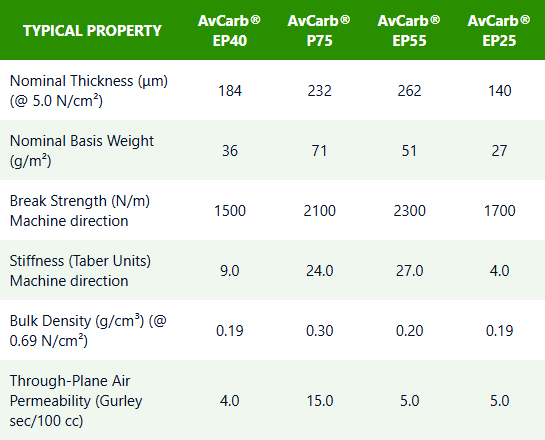
AvCarb Process combines high quality with product flexibility and continuous improvement:
Gas Diffusion Systems (GDS)
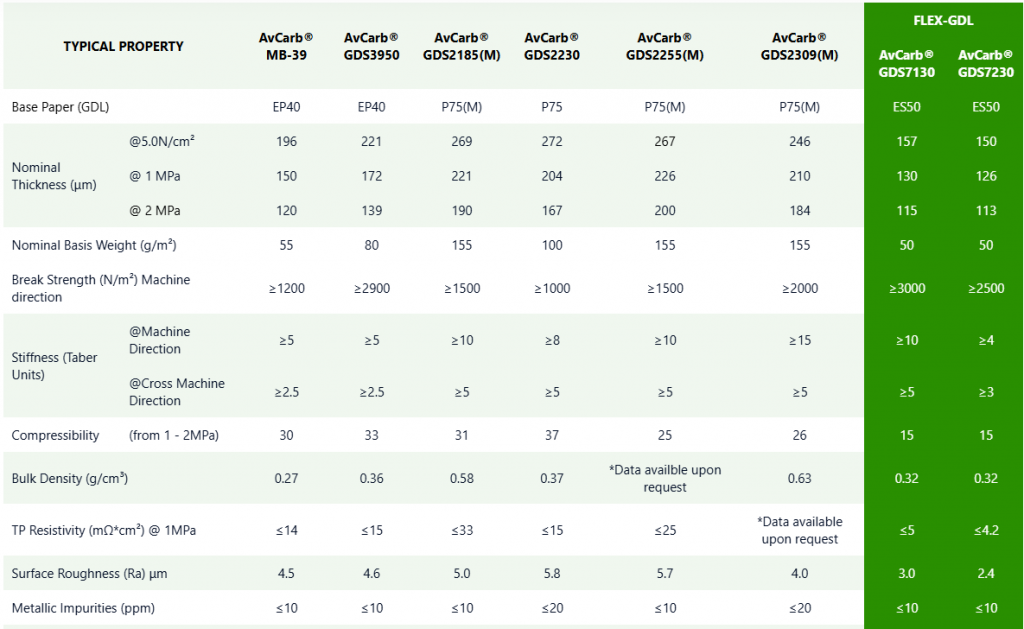
| TYPICAL PROPERTY | AvCarb® MB-39 | AvCarb® GDS3950 | AvCarb® GDS2185(M) | AvCarb® GDS2230 | AvCarb® GDS2255(M) | AvCarb® GDS2309(M) | FLEX-GDL | ||
| AvCarb® GDS7130 | AvCarb® GDS7230 | ||||||||
| Base Paper (GDL) | EP40 | EP40 | P75(M) | P75 | P75(M) | P75(M) | ES50 | ES50 | |
| Nominal Thickness (μm) | @5.0N/cm² | 196 | 221 | 269 | 272 | 267 | 246 | 157 | 150 |
| @ 1 MPa | 150 | 172 | 221 | 204 | 226 | 210 | 130 | 126 | |
| @ 2 MPa | 120 | 139 | 190 | 167 | 200 | 184 | 115 | 113 | |
| Nominal Basis Weight (g/m²) | 55 | 80 | 155 | 100 | 155 | 155 | 50 | 50 | |
| Break Strength (N/m²) Machine direction | ≥1200 | ≥2900 | ≥1500 | ≥1000 | ≥1500 | ≥2000 | ≥3000 | ≥2500 | |
| Stiffness (Taber Units) | @Machine Direction | ≥5 | ≥5 | ≥10 | ≥8 | ≥10 | ≥15 | ≥10 | ≥4 |
| @Cross Machine Direction | ≥2.5 | ≥2.5 | ≥5 | ≥5 | ≥5 | ≥5 | ≥5 | ≥3 | |
| Compressibility | (from 1 - 2MPa) | 30 | 33 | 31 | 37 | 25 | 26 | 15 | 15 |
| Bulk Density (g/cm³) | 0.27 | 0.36 | 0.58 | 0.37 | *Data availble upon request | 0.63 | 0.32 | 0.32 | |
| TP Resistivity (mΩ*cm²) @ 1MPa | ≤14 | ≤15 | ≤33 | ≤15 | ≤25 | *Data available upon request | ≤5 | ≤4.2 | |
| Surface Roughness (Ra) μm | 4.5 | 4.6 | 5.0 | 5.8 | 5.7 | 4.0 | 3.0 | 2.4 | |
| Metallic Impurities (ppm) | ≤10 | ≤10 | ≤10 | ≤20 | ≤10 | ≤20 | ≤10 | ≤10 | |
| Datasheet |

|
|
|
|
|
|
|
|
|
| Datasheet | Download | ||
| AvCarb® MB-39 |
|
||
| AvCarb® GDS3950 |
|
||
| AvCarb® GDS2185(M) |
|
||
| AvCarb® GDS2230 |
|
||
| AvCarb® GDS2255(M) |
|
||
| AvCarb® GDS2309(M) |
|
||
| FLEX-GDL | AvCarb® GDS7130 |
|
|
| AvCarb® GDS7230 |
|
||
GDS Selection Guide
Use the table to determine the diffusivity level of the GDL required for your application. Based on the target thickness under compression, match the diffusivity level to determine the best GDL for your application.


Special Considerations
For highest operating current densities (>2 A/cm²) always choose a high diffusivity material
For membrane thickness ≤ 10 microns choose a smooth MPL version (replace 2nd digit in product code with a 9 – e.g., GDS6950, GDS2930, MB-39, etc.)
Asymmetric GDL combinations (e.g., different anode and cathode designs) often provide optimal performance, but are more complicated to process. Please contact an expert to discuss your needs.
AvCarb’s Gas Diffusion Systems incorporate a hydrophobically treated AvCarb GDL, and a surface coated microporous layer, optimized for specific fuel cell construction and operating requirements. The designs are based upon 25 years of collaboration with world leading fuel cell manufacturers and span the full range of today’s operating environments. AvCarb’s best in class quality and manufacturing flexibility provides the best customer value minimizing manufacturing scrap and costly re-builds due to low performing cells and providing best in class durability with GDL performance shown for over 38,000 hours of continuous operation in some systems.


