Dr Jason Morgan, AvCarb, USA, outlines the steps for how a properly designed gas diffusion layer can remove bottlenecks and help keep up with a changing industry.
Polymer electrolyte membrane fuel cells (PEMFCs) have emerged as a cornerstone technology in the global transition towards decarbonisation, offering high power density and efficiency for a variety of clean energy applications. As the PEMFC industry accelerates its transition from stationary and material handling applications to high-power, heavy-duty transport, and distributed power systems, the engineering focus has shifted towards a well-documented challenge. Consequential system failures frequently associated with the catalyst layer are now starting to appear in the porous transport layers and interfacial regions that surround it. At the centre of this challenge is the Gas Diffusion Layer (GDL), a component once treated as a commodity, is now recognised as a critical determinant of stack performance and lifetime.
As OEMs push the boundaries of technology via thinner membrane electrode assemblies (MEAs), higher current densities, and extended target lifetimes, the limitations of conventional GDL designs have become well-documented performance bottlenecks, specifically in compressibility, electrical resistance, mechanical durability, and surface topology. This realisation has driven a shift toward greater material engineering rigour, culminating in the development of the FLEX-GDLTM. By examining the specific mechanical and electrical failure modes of conventional GDLs in modern fuel cells, this article will outline the engineering approach to overcoming these failures, ultimately illustrating why this release represents the next evolution in fuel cell material science.
The failure cascade: Why the GDL matters
Within a fuel cell the GDL must simultaneously manage reactant gas transport, water removal, electrical conduction, mechanical compliance, and heat dissipation. The failure of any single function creates a cascade effect that reduces the stack performance. For instance, a piece of GDL with high compressibility will easily conform around the plate during the stack build to help create the seal necessary for the fuel cell to work. However, if the GDL thickness is not uniform, both down-web and cross-web, then when compressed to a hard stop the pressure applied to individual GDL pieces may be different. This difference will impact the porosity of the GDL and thus the diffusion rate, perhaps creating additional mass transport loss or ‘low cells’ (individual cells in a stack that underperform due to localised transport restrictions). Even worse, if the GDL compressibility is inelastic then, as the membrane in the MEA swells and contracts against these thicker pieces during operation, the GDL thickness can creep lower, eventually becoming too thin to maintain the seal. This will cause a leak that compromises the entire stack for the thickness variation of a single piece of GDL. While the impact of GDL variations can be localised initially, these failures propagate stress to adjacent areas, reducing efficiency and ultimately compromising the performance of the entire stack. To mitigate these types of risks, the FLEX-GDL was engineered to address four critical failure points inherent in traditional designs.
Step one: Resolving the compressibility paradox
Conventional GDLs were designed with high compressibility to accommodate manufacturing tolerances in bipolar plates and other cell components. While this aided sealing, it introduced ‘silent efficiency killers’ such as channel intrusion (increasing pressure drop), permanent compression set (creep), and inconsistent contact pressure (increased resistance). Attempts to stiffen the material by increasing fibre density work, but often resulted in higher costs, reduced permeability, and increased risk of membrane damage. These solutions also limit the reduction in GDL thickness, preventing improvement in power density by reduction of cell pitch.
The engineering response
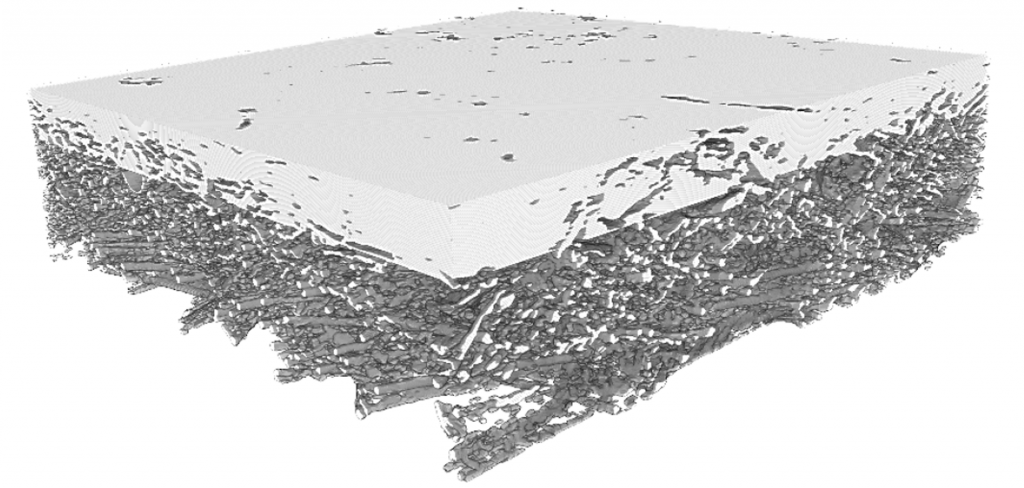
Technologies like FLEX-GDL reimagine the binder distribution strategy. Rather than relying on dense inter-fibre webbing, the binder reinforces individual carbon fibre junctions, thereby preserving open pore pathways while building load-bearing capacity. The result is a non-linear compression profile as seen in Figure 1. The material compresses readily below 1 MPa to facilitate sealing, but exhibits near-elastic behaviour above 1 MPa, with less than 15 μm of thickness change between 1 and 2 MPa and a permanent compression set of only 10 μm after cycling to 3 MPa. This dual-phase behaviour prevents channel intrusion and creep, ensuring consistent interfacial contact throughout the stack’s operational life.
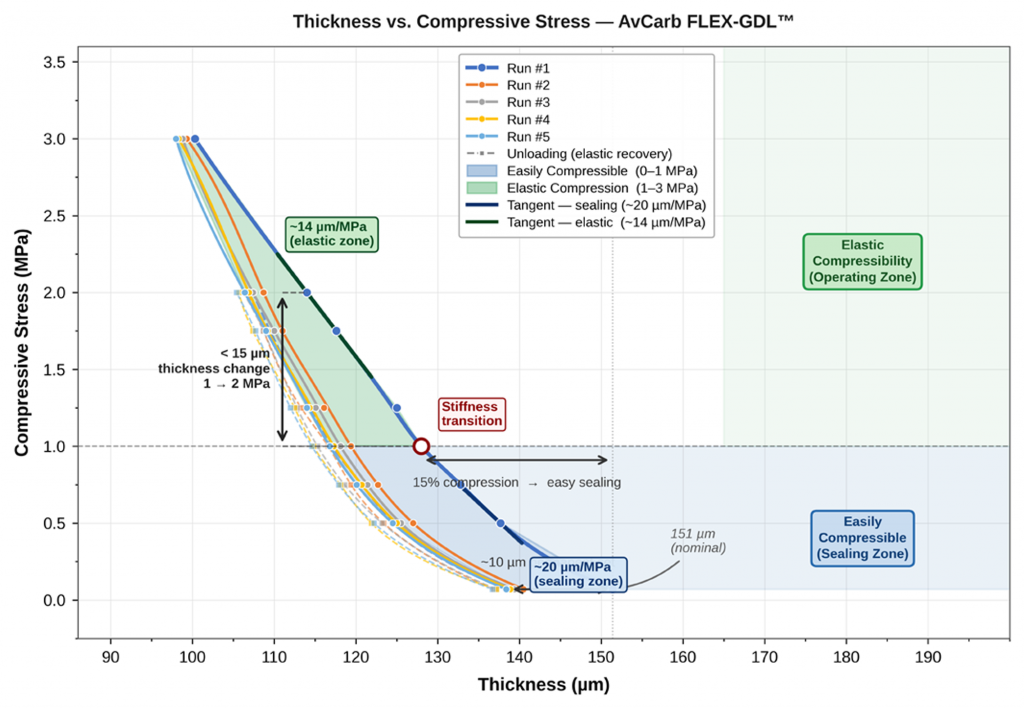
Figure 1.
Through-plane thickness as a function of compressive stress on FLEX-GDLTM. The material exhibits a dual-phase compression response with easy compression below 1 MPa for easy sealing and less compression at higher forces to prevent channel intrusion.
Step two: Minimising Ohmic losses via advanced hydrophobicity
Hydrophobic agents, typically polyterafluoroethylene (PTFE), are essential for water management and flood prevention. However, these agents act as electrical insulators. In standard GDLs, achieving the necessary hydrophobicity (contact angle - 140°) often requires PTFE loadings that significantly increase Ohmic resistance, forcing operators to choose between water management efficiency and electrical conductivity.
The engineering response
The new GDL design utilises a conformal coating process in which PTFE is deposited directly onto individual fibre surfaces rather than pooling at fibre junctions or bridging pore throats. This approach achieves equivalent hydrophobicity (contact angle ≥ 140°) with an 80% reduction in total PTFE content compared to conventional GDLs. The practical consequence is measurable: through-plane electrical resistivity is reduced from 7 mΩ·cm2 to 5 mΩ·cm2 at 1 MPa (a 30% reduction vs the prior-generation baseline) while water management performance is preserved. The result is a simultaneous improvement in electrical efficiency and material sustainability, without the traditional trade-off between hydrophobicity and conductivity.
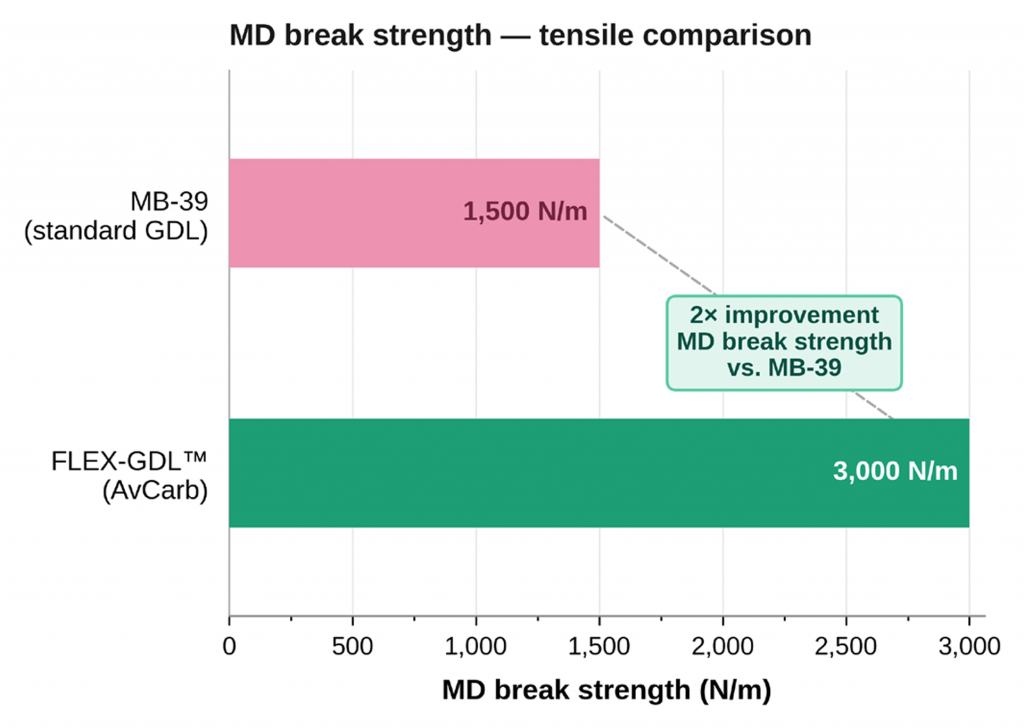
Figure 2.
Mechanical strength comparison between MB-39 and FLEX-GDL.
Table 1.
Physical property comparison between AvCarb MB-39 and AvCarb FLEX-GDL
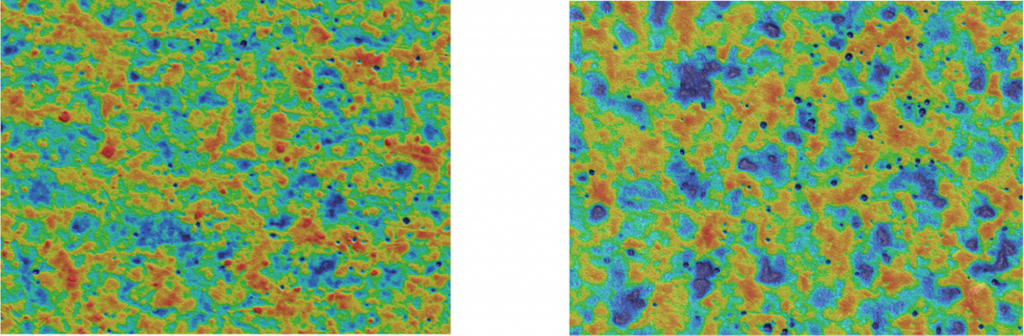
Figure 3.
Confocal laser microscope images of the FLEX-GDL MPL surface at nominal pressure (left) and at 2 MPa compressive load (right). Surface morphology is visually unchanged and measured average surface roughness (Ra) are identical at 2.4 and 2.35 μm respectively.